Introduction
In 1944, George Stinney Jr., a fourteen-year-old Black boy, was convicted of murdering two young white girls in South Carolina. Tried before an all-white jury in a proceeding lasting approximately three hours, Stinney was convicted after only ten minutes of deliberation and sentenced to death. He was executed in the electric chair less than three months after his arrest. Seventy years passed before a South Carolina judge vacated his conviction, finding that the proceedings failed to provide him with a fair trial [1]. Stinney’s case is a horrifying reminder that not only the American justice system has failed to prevent injustice but that our courts facilitated it.
Yet the problems exposed by Stinney’s execution are hardly confined to the past. In September 2026, Tennessee’s attempt to execute Christa Pike failed after officials administered two doses of pentobarbital, a lethal injection [2]. Pike had been sentenced to death at eighteen for the murder of Colleen Slemmer that she committed with her boyfriend Tadaryl Shipp. By virtue of being one year younger and technically a minor, Shipp was sentenced to life in prison with the possibility of parole for the same crime. Since the botched execution, the Tennessee Department of Corrections Officer has resigned, and Tennessee Governor Bill Lee has placed a moratorium on death sentences for the year [3]. Pike’s case is particularly novel not simply for her arbitrary sentence based on her age, or her defenses’ neglect of her severe childhood trauma, but a failed execution now requires a question of whether this has become cruel and unusual punishment. As demonstrated by the upheaval of the Tennessee Corrections Department, there has been a blatant error in our justice system. How can we justify capital punishment when the state cannot reliably control the process?
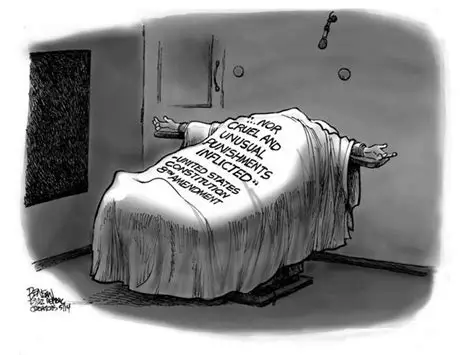
The Eighth Amendment prohibits “cruel and unusual punishment[s],” but the meaning of that prohibition has never been historically clear [4]. In Trop v. Dulles (1958), the Supreme Court established that the Amendment’s meaning must draw from the “evolving standards of decency that mark the progress of a maturing society” [5]. Since then, the Court has repeatedly narrowed the circumstances in which capital punishment may be imposed, excluding certain offenders and crimes, and demanding greater protections against arbitrary sentencing. Yet it has continued to uphold the death penalty as a constitutionally sanctioned punishment.
Although the Court reaffirmed the constitutionality of capital punishment in Gregg v. Georgia (1976), subsequent decisions have exposed persistent difficulties with proportionality, culpability, individualized sentencing, and administration [6]. The question is no longer how the state can execute more carefully, but whether a constitution committed to human dignity should execute at all. This article traces the evolution of the Supreme Court’s capital punishment jurisprudence, beginning with the constitutional foundations of “evolving standards of decency” and then continuing through the decisions that have progressively limited death eligibility. Consequently, it examines modern public attitudes, alternative punishments, the risk of executing the innocent, current disparities in administration, and continued controversy surrounding execution methods.
Constitutional Foundations of Evolving Standards of Decency
The Eighth Amendment’s intentions are to prevent the government from instituting punishments that are “cruel and unusual” [7]. Yet the amendment itself does not provide an exhaustive list of what does and does not constitute cruel and unusual punishment. Instead, its meaning is derived from judicial interpretation, reflecting changes in society’s understanding of cruelty and human dignity.
In the 19th century, the Supreme Court began to debate whether the standard for cruel and unusual punishment was fixed at the time of the Constitution or if it was an evolving standard. In Wilkerson v. Utah (1878) and In re Kemmler (1890), the Court decided if something was cruel and unusual by examining whether the framers would have considered it “cruel and unusual” in 1789 [8][9]. At the time, the Court felt that this test sufficiently reflected current norms surrounding just punishment. However, in the twentieth century, the Court became more flexible in its interpretation of the cruel and unusual standard. Particularly, in Weems v. United States (1910), the Court implicated “unnecessary and wanton infliction of pain” as cruel and unusual. The Weems Court interpreted the Eighth Amendment to have an “expansive and vital character” [10]. Constitutional protection against cruel and unusual punishment would not be meaningful if it could not account for forms of cruelty that society had not yet recognized.
Finally, in 1958, the Court set the standard guide for the interpretation of cruel and unusual punishment. In Trop, the plurality opinion wrote that the amendment “must draw its meaning from the evolving standards of decency that mark the progress of a maturing society” [11]. Although Trop did not concern a death sentence, its reasoning established that the Eighth Amendment must be interpreted in the context of the society that it governs, and should adapt as our understanding of human dignity does.
The doctrine does not necessarily mean that every change in public opinion renders a punishment unconstitutional—no interpretation can rely on sentiment alone. In its capital punishment cases, the Court has considered contemporary standards including legislative enactments, the frequency a punishment is imposed, and the “national consensus” [12]. This principle is particularly apt when considering capital punishment. As society evolves, so too does our understanding of “decency,” and thus those punishments which we may have viewed as just in the past no longer hold merit. However, these considerations do not necessarily mean that the Eighth Amendment’s interpretation is entirely dependent on public opinion, nor does a decline in support for a particular punishment automatically render it unconstitutional. Rather, the doctrine recognizes that constitutional meaning can develop as society’s understanding of justice changes. The challenge lies in determining when these changes are sufficiently significant to require a change in interpretation of the Constitution.
The Court’s modern death penalty jurisprudence traces this tension and reflects our society's evolution of morals. In Furman v. Georgia (1972), the Court invalidated capital punishment when administered in an “arbitrary” and “capricious” manner [13]. Later in Gregg, the Court backtracked and concluded that the death penalty was not categorically unconstitutional and upheld a sentencing scheme designed to reduce arbitrariness [14]. But Gregg did not establish that every future application of the death penalty would be constitutional, nor did it limit the Court's ability to adapt to changing social standards. A series of later decisions narrowed the penalty further in line with our “evolving standards of decency.” If evolving standards of decency can render previously permissible applications of capital punishment unconstitutional, it should not be out of bounds to reconsider the punishment as a whole unconstitutional under the same principle.
To summarize: Have the safeguards endorsed by Gregg sufficiently addressed the concerns that led to the Court’s decision in Furman? If capital punishment still produces arbitrary outcomes, remains vulnerable to error and unequal treatment, and faces growing public doubt about its necessity, what justifies keeping a patently irreversible punishment?
Defining Cases on the Constitutionality of the Death Penalty
In 1972, William Henry Furman challenged his death sentence before the Supreme Court after being convicted of murder during an attempted burglary. According to the account of the incident, Furman was discovered by a resident while burglarizing the home, and in an attempt to flee, fell and discharged his firearm, killing the resident. His case was considered alongside two other capital cases involving rape, debating the question: Does the imposition and carrying out of the death penalty in these cases constitute cruel and unusual punishment in violation of the Eighth and Fourteenth Amendments? [15]. In a five-to-four decision, the Court ruled that the death sentences at issue were unconstitutional and qualified as cruel and unusual punishment. The plurality opinion held that the “arbitrary” and “capricious” distribution of the death penalty was unconstitutional due to its frequent discriminatory and ineffective distribution. Furman’s central concern was not whether a particular offense warranted the death penalty, but rather whether the processes by which it was administered were “arbitrary” and “capricious” [16]. The Court’s decision renewed attention to evidence that the death penalty was disproportionately imposed on marginalized populations, including African Americans and those without the resources to defend themselves properly. In doing so, Furman produced a de facto moratorium, or a suspension, on the death penalty until states could reform their systems to align with the proper practices.
Notably, in his concurrence, Justice Thurgood Marshall went beyond the per curiam to argue that capital punishment is never constitutionally permissible. For Marshall, the debate was not a matter of whether society condemned murder or rape, but whether capital punishment was "a punishment no longer consistent with our own self-respect" and, therefore, violative of the Eighth Amendment [17]. He examined six purposes commonly used to support the death penalty: retribution, deterrence, prevention of repetitive criminal acts, encouragement of guilty pleas and confessions, eugenics, and economy. He argued that there is nothing that execution accomplishes that would not be better achieved by life imprisonment without the irreversible risk of taking an innocent life. He also further emphasized the rampant discrimination in the distribution of capital punishment, identifying the poor, the illiterate, the underprivileged, and members of minority groups as most vulnerable to becoming “society's sacrificial lamb” [18]. His concurrence is particularly apt because his central contention is that an irreversible punishment administered by an imperfect institution cannot be just.
Four years later, however, the Supreme Court revisited the constitutional status of capital punishment in Gregg v. Georgia. In 1976, after being convicted of double murder during an armed robbery and sentenced to death, Petitioner Troy Gregg appealed the court's decision on the grounds that capital punishment constituted cruel and unusual punishment. Here, the Court had to directly address whether or not the imposition of the death penalty itself was prohibited under the Eighth and Fourteenth Amendments. In the plurality opinion, the Court ruled that the death penalty was not categorically unconstitutional and upheld Georgia’s revised sentencing scheme. Crucially, the Court did not overturn the precedent set by Furman; the Court claimed that the concerns of arbitrariness or capriciousness could be met by a statute that provided for a bifurcated proceeding with standards to guide its use of that information [19].
Gregg and Furman established that though the death penalty is constitutionally permissible, it must be governed by statutes that prevent “arbitrary and capricious” sentences. Furman established the deficiencies in arbitrary sentencing; Gregg permitted capital punishment, surmising that procedural safeguards could remedy those deficiencies. These precedents placed an enduring burden on states to ensure the death penalty was administered consistently and justly. Justice Marshall, notably, maintained his opposition to capital punishment, arguing that it rested upon “the total denial of the wrongdoer’s dignity and worth” [20]. His dissent in Gregg contended that procedural reforms will never sufficiently manage such an irreversible punishment.
Cases that Limit Process
The Supreme Court followed the trajectory set by Furman and its jurisprudence has increasingly emphasized that the death penalty cannot be imposed indiscriminately. The punishment must be proportionate to the crime, reflect the defendant's culpability, and account for due process of law.
In Woodson v. North Carolina (1976), the Court ruled that a law that mandated the death penalty for all those convicted of first-degree murder was unconstitutional. This was on account of the law's “depart[ing] markedly from contemporary standards” concerning death sentences, the lack of standards to guide juries in their exercise of "the power to determine which first-degree murderers shall live and which shall die," and the failure to allow consideration of the character and record of individual defendants [21]. Two years later, the Court even further clarified the necessity for individualized sentencing. In Lockett v. Ohio (1978), the Court stated that the Ohio mandatory sentencing law, even with qualifications such as if the victim had induced the offense, the offense was committed under duress or coercion, or the offense was a product of mental deficiencies, was nonetheless unconstitutional. The sentencer must be able to consider any relevant evidence such as the defendant’s background, mental health, and explicit role in the offense [22]. The capital punishment cannot be applied blanketly without individualized scrutiny.
Limits on Death Sentencing
The Court has imposed similar limits on the crimes and offenders eligible for execution. In Coker v. Georgia (1977), it held that the death penalty was disproportionate for the rape of an adult woman when the victim was not killed [23]. In Kennedy v. Louisiana (2008), it extended that principle to the rape of a child where the victim did not die and the offense was not intended to result in death [24]. These decisions recognize that the severity of a crime does not itself establish that execution is proportionate.
The distinction between the gravity of the offense and the offender’s culpability in felony-murder cases was clarified in the 1980s. In Enmund v. Florida (1982), the Court held that a defendant who neither killed, attempted to kill, nor intended to kill, could not be sentenced to death merely because a killing occurred during a felony in which they participated [25]. Tison v. Arizona (1987) clarified that participants whose role was minor in a felony who did not kill and lacked intent to kill cannot be sentenced to death; only major participants showing “reckless indifference to human life” qualify [26]. These ruling further narrowed what sorts of crimes or involvement in crimes warranted the death penalty.
Finally, Atkins v. Virginia (2002) excluded people with intellectual disabilities from execution, recognizing limitations in culpability [27]. Similarly, Roper v. Simmons (2005) held that executing offenders for crimes they committed under Eighteen violated the Eighth Amendment [28]. In both cases, the Court ruled that characteristics affecting an offender's capacity for judgment and responsibility can make the death penalty unjust. Hall v. Florida (2014) rejected Florida’s use of an IQ score of 70 as a cut off that prevented consideration of other evidence of intellectual disability [29]. The Court reasoned that the execution of mentally disabled criminals would not “measurably advance the deterrent or the retributive purpose of the death penalty" [30]. These decisions reflect a broader precedent that a state cannot determine that a person is deserving of death by sorting them into a broad category of criminal conduct.
III. Does Capital Punishment Still Serve a Necessary Purpose?
Retribution and Deterrence
Recently, Pete Hegeseth, the U.S. Secretary of War, made the call to live stream the execution of the Fort Hood Shooter via firing squad. He claimed, “We’re gonna make sure that people are able to watch it, that it’s public, because people need to understand that there’s serious consequences for these types of things” [31]. After a public outcry, President Trump backtracked his previous support and cancelled the live stream because “many very good and well-meaning people would rather not watch him die” [32]. In the modern era, we already see children and adults alike becoming desensitized to violence because of the frequent livestreaming of violent video games [33]. When we apply this pattern to something as grave as an execution, the consequences may not be as Hegeseth intended. Will live-streaming deter or desensitize?
Hegeseth’s justification is not novel; in fact, retribution and deterrence are some of the most traditional defenses of the death penalty. Retribution holds that certain crimes are so serious that death is the only proportional response. Retribution, however, is easily dismissed as a moral judgment rather than an empirical claim. Justice Marshall said it best when he said: “Retaliation, vengeance, and retribution have been roundly condemned as intolerable aspirations for a government in a free society” [34].
Deterrence on the other hand is a much more legally supported justification for the death penalty. Deterrence is the concept that the very threat of the death penalty will discourage future heinous crimes. Although if the justification for execution is that it prevents these crimes, then the state must prove that the death penalty is significantly more effective than life imprisonment. And in fact, empirically, the death penalty has not been proven to be a meaningful deterrent for crime [35]. Deterrence was an understandable justification in independent small rural communities that lacked the infrastructure to manage criminals. But we are no longer those communities, and just as the public was outraged by the prospect of a live execution, we have moved beyond that era of retribution and deterrence.
Necessity and the Availability of Alternatives
Another frequent defense of capital punishment is its necessity for protection. When we consider recidivism prima facie, the death penalty is the best solution, however, in light of the facts this does not hold up. First, murderers are very unlikely to commit crimes in prison or post release, in fact most are model citizens [36]. Second, in a capital case the jury is never asked to determine the defendant's likelihood of recidivism [37]. Third, most people who commit capital crimes aren’t executed [38]. Justice Marshall summarized in his Furman concurrence that if capital punishment were justified solely on preventing recidivism, then it would be exceedingly excessive, as it would be absurd to eliminate all capital offenders [39].
Irreversibility and the Risk of Killing the Innocent
The most significant distinction between capital punishment and life without parole is the aspect of irreversibility. A wrongful prison sentence can in theory be vacated; however, a wrongful execution can never be undone. The American justice system has repeatedly demonstrated that convictions are not by any means infallible. New evidence, recanted testimony, advanced forensic analysis, and discovery of police or prosecutorial misconduct can expose errors years after a conviction. Appellate review and certain post-conviction procedures can reduce risk, but to assume that our justice system can guard against every potential misdeed would be naive.
Since 1973, one in every 8.2 persons who have been executed have been exonerated [40]. The conditions which determine one’s “culpability” in a court of law are in fact rarely connected to the literal facts of the case. More than 100 people were executed in Texas after U.S. Supreme Court case precedent had already established the unconstitutionality of their death sentences [41]. Likewise, one’s quality of counsel has a direct impact on the likelihood of a death sentence: those with poorly trained, underfunded court counsel are much more likely to be sentenced to death over those with experienced counsel [42]. Even an accused’s state or county can arbitrarily determine the likelihood of a capital conviction. Just five counties make up ⅕ of all executions in the U.S. (Harris, TX; Dallas, TX; Bexar, TX; Tarrant, TX; and Oklahoma, OK), notably states with worse access to meaningful judicial review [43]. The arbitrary and capricious conditions that the death penalty is still decided in harken back to the concerns of Furman. Can we ever fully ensure a just application of the death penalty?
VI. Contemporary Standards of Justice
Although the principle of evolving standards of justice cannot be determined on public opinion alone, the history of public attitudes towards capital punishment nevertheless provides an important context for understanding if the practice continues to reflect society’s understanding of justice.
In 1994, Gallup recorded support for the death penalty at approximately eighty percent of Americans. By October 2025, this figure reached its lowest, having fallen to fifty-two percent, while opposition had risen to forty-four percent [44]. Ultimately, Gallup's trend shows that support for capital punishment has dwindled since 1972. Understandably, these figures do not establish that the American public has categorically rejected the death penalty; however, they do demonstrate a substantial change in support as time has progressed.
Moreover, differentiation between support for the death penalty in principle versus support for its use in practice is of particular import. A person may believe that some crimes deserve an irreversible punishment while still having serious concerns regarding whether the government can administer it justly. Others may support life imprisonment with no parole as an alternative that protects public safety while avoiding the irreversible consequences of a death sentence. Echoing Justice Marshall’s opinion in Furman, if life imprisonment can incapacitate a defendant and protect the public, the burden is on the state to explain what execution contributes that no alternative punishment can provide. When support for execution declines substantially, the Court and legislature are obligated to consider if our current practices are truly reflecting the values of those they are supposed to serve.
Conclusion
The Supreme Court has recognized that the Eighth Amendment must be interpreted in light of changing understandings of human dignity and justice. The Court has repeatedly relied upon that principle to conclude that punishments once permitted cannot be applied in every circumstance. The same principle invites a broader question about whether capital punishment, considered as a whole, remains compatible with contemporary constitutional values.
The modern problems surrounding execution prove that question difficult to avoid. The possibility of wrongful convictions, the uneven administration of capital sentences, the availability of life imprisonment without parole, and the continuing litigation over execution methods all challenge the premise that the state can administer death reliably and humanely.
Many may hope that our standards of justice have evolved beyond those that permitted George Stinney’s execution. But the lesson of his case is not merely that the past was cruel or that the system once failed, it is that constitutional safeguards are only as meaningful as the institutions responsible for enforcing them—and that no procedural reform can restore a life once the state has taken it.
The history of the death penalty shows a recurring effort to narrow its reach in the name of proportionality, fairness, and human dignity. Whether those restrictions can ever fully resolve the problems inherent in an irreversible punishment remains the central question. Perhaps the final measure of an evolving standard of justice is not how carefully the state chooses whom to execute, but whether a society committed to constitutional dignity can justify execution at all.